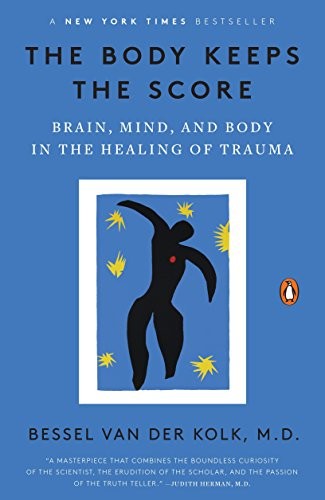
The old armchair in the corner of my small apartment had become my sanctuary, or perhaps, my cage. It was late autumn, the kind of day where the light was perpetually grey, filtered through rain-streaked windows, casting long, blurry shadows across the room. My hands, often restless, found a peculiar calm in turning the heavy pages of The Body Keeps the Score. The cover felt substantial, almost intimidating, a dark blue with stark white lettering. I remember the faint smell of old paper and something else, a hint of coffee from a forgotten spill, a scent that became intertwined with the intense, often overwhelming, information I was trying to absorb.
Outside, the city hummed with a distant, muffled roar, but in that armchair, surrounded by half-read books and a cooling mug of tea, the world felt compressed. My shoulders were permanently hunched, a familiar knot of tension residing between my shoulder blades, and my stomach often felt a peculiar sort of churn, a low-level anxiety that had become my constant companion. I'd spent years trying to rationalize these physical manifestations away, telling myself it was stress, or diet, or simply "how I was wired." But holding this book, feeling its weight, something shifted. It wasn't just my mind that was troubled; my very bones, my breath, my gut, seemed to be holding a story I hadn't yet learned to read.
The Idea That Stayed With Me
Bessel van der Kolk's central assertion, the one that truly anchored itself in my mind, was that trauma isn't just a psychological event stored as a bad memory in the narrative parts of our brain. Instead, it’s a profound physiological disruption, literally hardwired into our brains and bodies, long after the immediate danger has passed. He posits that trauma fundamentally alters the brain's alarm system, making us hypersensitive to potential threats even when we are objectively safe. Our amygdala, the brain's fear center, becomes overactive, while the prefrontal cortex, responsible for logic and reasoning, can go offline. This means that when triggered, we're not responding to the present moment as much as we are re-experiencing the past, our bodies flooded with stress hormones, our nervous systems stuck in fight, flight, freeze, or fawn responses.
What struck me most was the idea that our bodies, our very cells, retain the imprint of traumatic experiences. It's not just a metaphor; the body keeps a literal score. This manifests in countless ways: chronic pain, autoimmune issues, digestive problems, hypervigilance, emotional numbness, or an inability to feel safe and present. Our sense of self, our ability to regulate emotions, our relationships – all can be deeply affected. Van der Kolk explains that because traumatic memories are often stored as sensory fragments rather than coherent narratives, they bypass the verbal, conscious mind. This is why "talking it out" often isn't enough; the body needs to be involved in the healing process. Healing, then, isn't about forgetting or simply understanding; it's about helping the body complete defensive actions that were interrupted, restoring a sense of agency, and integrating these fragmented experiences so the nervous system can learn that safety is possible again. He explores various modalities, from yoga and EMDR to neurofeedback and theater, all aimed at helping the body and brain move out of a state of chronic defense and into a state of present-moment awareness and self-regulation. The implication is profound: true healing requires engaging with our entire organism, not just our thoughts.
My Unquiet Gut
For years, my stomach had been a battlefield. Bloating, cramps, a persistent, gnawing ache that doctors had dismissed as IBS, prescribing diet changes and stress reduction, neither of which truly touched the core of the discomfort. It was a constant, low-level buzz of distress that colored every meal, every social gathering, every quiet evening alone. I’d try to meditate, to breathe, but the tension in my gut felt like a physical barrier, an iron knot. I’d resent it, curse it, feeling trapped inside a body that seemed to betray me. This went on for well over a decade, a background hum of discomfort that became so normalized, I almost stopped noticing it consciously, though it dictated so much of how I lived.
One particular evening, I was curled up in that same armchair, the rain still drumming outside, and I was rereading a chapter about the vagus nerve and its role in regulating our "gut feelings." Van der Kolk described how chronic stress and unresolved trauma could dysregulate the autonomic nervous system, manifesting vividly in digestive issues. He spoke of the brain-gut axis, explaining that the enteric nervous system in our gut is often called a "second brain," highly responsive to our emotional state, especially states of fear and anxiety. I remember a wave of something akin to recognition, not quite understanding, but a deep, somatic "Oh." It wasn't just "stress," it was my body, my gut, quite literally echoing a history of unmet needs and unexpressed fears, of a nervous system perpetually on high alert.
It wasn't a sudden cure, not by a long shot. But in that moment, for the first time, I didn't feel angry at my gut. I felt a strange sense of compassion. This wasn't a flaw; it was a symptom, a messenger. The book had given me a new lens, not just for my past, but for my present, daily experience. I started to approach my stomach differently. Instead of fighting the discomfort, I began to acknowledge it, to gently place a hand over my abdomen and just… feel it. I started exploring somatic practices, like gentle yoga and mindful breathing, not as a way to fix something broken, but as a way to listen, to be present with the sensations. There were still difficult days, the gnawing ache didn't vanish overnight, but the narrative shifted. It wasn't me against my body anymore. It was me, finally listening to a part of myself that had been screaming in a language I didn’t understand, until van der Kolk offered me a dictionary. It was a slow, sometimes frustrating process of re-establishing a relationship with my physical self, a relationship based on curiosity and acceptance rather than judgment. And while the journey is ongoing, the quiet dignity of my gut's persistent message now feels like a part of my story, rather than just a problem to be solved.
What I'd Tell Someone Starting This Book
- This isn't a light read. Go in prepared for dense science and difficult stories. Take breaks when you need them.
- Don't expect a prescriptive "how-to" guide. It offers understanding and frameworks, not instant solutions. Its value is in expanding your perspective.
- Pay attention to how your own body responds as you read. If a passage triggers strong feelings or physical sensations, acknowledge them without judgment.
- Consider exploring the therapeutic modalities mentioned, but always with a qualified professional. This book provides context, not therapy itself.
- It’s okay if some parts feel overwhelming or don't resonate immediately. Let the ideas marinate; sometimes understanding unfolds over time.